Monday morning I set out for the Waterfront to meet up with some runners who are participating in the Pittsburgh Marathon events Run for a Reason, raising money for the Greater Pittsburgh Community Food Bank. Even though I love to run races, it's actually pretty far out of my comfort zone to run with strangers, particularly on a trail I've never run before (Steel Valley). Oh yeah, and in the snow.
We set off from the trail head at the historic Homestead Pump House and ran just over 4 miles down the trail to the Food Bank's building in Duquesne. (Though I ended up running 5, since I didn't heed anyone's directions and in the zone, just kept going down the trail for another half mile until I realized I wasn't in Kansas anymore and had to turn back. Well done, Joanna.)
After the run, we had some refuel snacks and warmed up before we toured the facility and learned all about the organization we're running for. (And we also met former Steeler Andy Russell, who is a huge supporter of the GPCFB's efforts. He signed the mug pictured above!)
I thought I knew the general extent of the services the food bank provides, but until I walked around the warehouse and saw everything up close, I had no real idea of how vast an operation it actually is. The amount of assistance they provide is just amazing - 27 million pounds of food each year, to people in 11 counties through their 400+ member agencies.
As if that isn't impressive enough, the food bank has a focus on providing healthy food. I think people assume that food banks just focus on getting people food in general and don't worry about the nutritional value. But the food bank has many programs that address nutrition as well - and many initiatives behind the scenes as well. For instance, their Produce to People program distributes fresh food in 15 different locations. It makes me really happy to know that - because everyone deserves healthy food.
They are still looking for more runners to Run for a Reason. If you're running one of the Pittsburgh events this year, join the Food Bank team! They will be having more group fun runs throughout the training season (and hopefully beyond!) and it's a great way to combine fitness with a good cause.
You can donate to my fund here and even join the team from that site. After the event, I'll randomly select one donor and he or she will receive the mug pictured above, signed by Steel Curtain Steeler Andy Russell!
Wednesday, January 22, 2014
Monday, January 20, 2014
GMO culture war - is there a middle ground?
Recently, a reporter from Grist, one of the country's premiere environmental magazines, finished a sixth month series on GMOs. He used the series to investigate the truth about GMOs outside of the two opposing narratives that are usually circulated. On one hand you have the pro-GMO people, who see GMOs are a feat of human ingenuity and technology/science that will save agriculture as we know it and go a long way to address starvation and hunger across the globe. On the other hand, the anti-GMO people, who see GMOs as a symptom of corporate control of our food system and the unsustainability of modern agriculture, not to mention a health risk.
His wrap-up piece, "What I learned from six months of GMO research: none of it matters" caused a huge stir, from both sides of the debate. He concluded that the cultural debate actually misses the mark. Since it talks about GMOs in a broad sense, it doesn't allow for discussion of individual GMO plants or organisms. He argues there's a difference between engineering rice to feed starving people and engineering corn to feed pigs in a nation that already eats too much meat. (I need to read the series to see how he feels about genetically engineered animals, like salmon.)
I haven't read all of the pieces in the series (though I probably will start to go through them). And Civil Eats also addressed his piece on their site, with a compelling rebuttal. In particular, that essay addresses what agricultural priorities should be if we are trying to envision a sustainable future. And points out rightfully that the companies involved in GMO technology are also the ones that poisoned us with Agent Orange, etc. The writer acknowledges that the debate does obscure the technological innovations that do need to occur in order to move toward sustainability.
For me, the GMO issue primarily comes down to the issue of transparency. If I believed that as a nation we could keep corporations accountable to make decisions in the public interest, it would be one thing. But we can't, and we know that much of the scientific research being done about GMOs (all types) is controlled by parties with a financial interest. We need third party research that's independent. That encourages human innovation and scientific development, but with an eye toward sustainability. That researches the health and environmental effects of these plants. And we need a system that errs on the side of caution, not risk, when it comes to public health.
While I don't agree with him entirely - I think we need to avoid adopting a flippant attitude about GMOs - Nathanael Johnson's Grist piece is food for thought and encourages us to dig through the hype for what's actually true when we talk about GMOs.
His wrap-up piece, "What I learned from six months of GMO research: none of it matters" caused a huge stir, from both sides of the debate. He concluded that the cultural debate actually misses the mark. Since it talks about GMOs in a broad sense, it doesn't allow for discussion of individual GMO plants or organisms. He argues there's a difference between engineering rice to feed starving people and engineering corn to feed pigs in a nation that already eats too much meat. (I need to read the series to see how he feels about genetically engineered animals, like salmon.)
I haven't read all of the pieces in the series (though I probably will start to go through them). And Civil Eats also addressed his piece on their site, with a compelling rebuttal. In particular, that essay addresses what agricultural priorities should be if we are trying to envision a sustainable future. And points out rightfully that the companies involved in GMO technology are also the ones that poisoned us with Agent Orange, etc. The writer acknowledges that the debate does obscure the technological innovations that do need to occur in order to move toward sustainability.
For me, the GMO issue primarily comes down to the issue of transparency. If I believed that as a nation we could keep corporations accountable to make decisions in the public interest, it would be one thing. But we can't, and we know that much of the scientific research being done about GMOs (all types) is controlled by parties with a financial interest. We need third party research that's independent. That encourages human innovation and scientific development, but with an eye toward sustainability. That researches the health and environmental effects of these plants. And we need a system that errs on the side of caution, not risk, when it comes to public health.
While I don't agree with him entirely - I think we need to avoid adopting a flippant attitude about GMOs - Nathanael Johnson's Grist piece is food for thought and encourages us to dig through the hype for what's actually true when we talk about GMOs.
Friday, January 17, 2014
picking your ethical battles as a consumer
In our global economy, where much of what we consume from foods to retail goods is produced overseas, it's hard to know not only what you are getting, but who made it and where. "Ethically sourced" and "conflict free" are some of the buzz words surrounding this issue. They come up in the media when a large-scale tragedy occurs (such as the collapse of a garment factory in Bangladesh that killed more than 1,000 workers) or a lawsuit is filed (such as the one filed against Apple for child labor in its Chinese factories).
We're outraged when we hear about these incidents, and rightfully so. And they go on and on. Diamonds that are called "conflict" or "blood" diamonds (because they are illegally mined and sold to fund wars in war zones. Chocolate harvested by children who are also enslaved. Smart phones with parts made in Asian factories with bad conditions and gold mined with child labor in Africa. Coffee and other crops harvested with little to no profit to the grower. Beloved cookies made with palm oil, which destroys habitat for animals and precious rainforest. You could write for days on each of these issues and the conflicts they create.
Many of these lines are murky. For instance, it is almost entirely impossible to source a conflict-free diamond unless it's made in a laboratory. Once diamonds are brought in for trade, they are legitimized and their "dirty histories" wiped away. (See this enlightening article for details on why this is the case.) And while most people are interested in the use of diamond profit to fund wars, there's also the issue of who mines those stones in the first place - children.
The same goes for smart phones. An ever-expanding electronic industry has made the demand for gold and the other minerals (copper, cobalt, tin, etc.) used in production increase, and Human Rights Watch has questioned the use of child labor in very dangerous mining jobs. Like diamonds, it's nearly impossible to buy an ethically "clean" smart phone. The supply chains for the hundreds of materials used to create a phone are complex, diverse and sometimes untraceable.
I only very rarely eat chocolate that is not fair trade or organic. (See this post - did a slave harvest the cocoa in your candy bar? for details.) I don't eat at fast food restaurants for a variety of ethical reasons that go beyond health.
I also wear an engagement ring with a diamond in it. I use a smart phone and a Chromebook.
I buy as much produce and meat from local farms as possible, and buy other handmade, local products when I can.
I wear clothes that I purchase at retail stores that don't say "Made in the USA" on the tags. Or that the cloth it was made from is produced there either.
So what do you do? What do you do if you want to be an ethical consumer in a world where those lines are sometimes virtually impossible to understand?
My philosophy is this. I heard during a lecture once (or read in a book maybe?) that you can judge a person by the integrity of their compromises. For myself, I try to pick battles that meet two criteria: (1) it's within my control and (2) has a reasonable alternative which can satisfy my ethical conundrum.
I can choose to not purchase produce and other food products (meat, dairy, etc.) which are not produced and farmed in a manner I approve of, and a reasonable alternative is to buy them locally and be a member of a CSA. I don't eat at fast food restaurants because I can reasonably choose local restaurants where many of my ethical issues with fast food are not present. Or I can just not eat out at all. (Novel idea!) Chocolate isn't even a necessary food in the first place, but if I want chocolate, I can buy fair trade or organic chocolate, which satisfies my issue with child labor and slavery practices.
But I am going to choose to use a cell phone and to keep wearing my engagement ring. Because I can't buy a locally made cell phone as an alternative, there's no one who benefits from me not purchasing that one phone. I would be better off supporting organizations such as Human Rights Watch, which use their lobbying power to help change legislation to protect labor forces and get corporations (such as Apple and other electronics manufacturers) to own up to their supply chains and face monetary penalties for not doing so.
That being said, I don't need to go overboard on my consumption of retail goods in the first place. I realize that there are many other ways in which I could live my life "more ethically" and I try to think through purchases and understand what role I play in the world by being a consumer. I also do my best to research and understand what's at stake with a particular issue, so that I'm not just hopping on a trendy, petition-signing bandwagon.
At the end of the day, I hope my compromises can be judged to be made with integrity, in the absence of perfection.
We're outraged when we hear about these incidents, and rightfully so. And they go on and on. Diamonds that are called "conflict" or "blood" diamonds (because they are illegally mined and sold to fund wars in war zones. Chocolate harvested by children who are also enslaved. Smart phones with parts made in Asian factories with bad conditions and gold mined with child labor in Africa. Coffee and other crops harvested with little to no profit to the grower. Beloved cookies made with palm oil, which destroys habitat for animals and precious rainforest. You could write for days on each of these issues and the conflicts they create.
Many of these lines are murky. For instance, it is almost entirely impossible to source a conflict-free diamond unless it's made in a laboratory. Once diamonds are brought in for trade, they are legitimized and their "dirty histories" wiped away. (See this enlightening article for details on why this is the case.) And while most people are interested in the use of diamond profit to fund wars, there's also the issue of who mines those stones in the first place - children.
The same goes for smart phones. An ever-expanding electronic industry has made the demand for gold and the other minerals (copper, cobalt, tin, etc.) used in production increase, and Human Rights Watch has questioned the use of child labor in very dangerous mining jobs. Like diamonds, it's nearly impossible to buy an ethically "clean" smart phone. The supply chains for the hundreds of materials used to create a phone are complex, diverse and sometimes untraceable.
I only very rarely eat chocolate that is not fair trade or organic. (See this post - did a slave harvest the cocoa in your candy bar? for details.) I don't eat at fast food restaurants for a variety of ethical reasons that go beyond health.
I also wear an engagement ring with a diamond in it. I use a smart phone and a Chromebook.
I buy as much produce and meat from local farms as possible, and buy other handmade, local products when I can.
I wear clothes that I purchase at retail stores that don't say "Made in the USA" on the tags. Or that the cloth it was made from is produced there either.
So what do you do? What do you do if you want to be an ethical consumer in a world where those lines are sometimes virtually impossible to understand?
My philosophy is this. I heard during a lecture once (or read in a book maybe?) that you can judge a person by the integrity of their compromises. For myself, I try to pick battles that meet two criteria: (1) it's within my control and (2) has a reasonable alternative which can satisfy my ethical conundrum.
I can choose to not purchase produce and other food products (meat, dairy, etc.) which are not produced and farmed in a manner I approve of, and a reasonable alternative is to buy them locally and be a member of a CSA. I don't eat at fast food restaurants because I can reasonably choose local restaurants where many of my ethical issues with fast food are not present. Or I can just not eat out at all. (Novel idea!) Chocolate isn't even a necessary food in the first place, but if I want chocolate, I can buy fair trade or organic chocolate, which satisfies my issue with child labor and slavery practices.
But I am going to choose to use a cell phone and to keep wearing my engagement ring. Because I can't buy a locally made cell phone as an alternative, there's no one who benefits from me not purchasing that one phone. I would be better off supporting organizations such as Human Rights Watch, which use their lobbying power to help change legislation to protect labor forces and get corporations (such as Apple and other electronics manufacturers) to own up to their supply chains and face monetary penalties for not doing so.
That being said, I don't need to go overboard on my consumption of retail goods in the first place. I realize that there are many other ways in which I could live my life "more ethically" and I try to think through purchases and understand what role I play in the world by being a consumer. I also do my best to research and understand what's at stake with a particular issue, so that I'm not just hopping on a trendy, petition-signing bandwagon.
At the end of the day, I hope my compromises can be judged to be made with integrity, in the absence of perfection.
Wednesday, January 15, 2014
corporate involvement with kids: how much is too much?
Two recent news stories have highlighted the issue of corporate involvement with children on environmental and nutritional subjects. These incidents included advertising as well as education, and I think they illustrate clearly the importance of corporate responsibility – something we clearly lack.
In Ohio, the oil and gas industry under the auspices of the Ohio Oil and Gas Energy Education Program created a program sponsored by Radio Disney called “Rocking in Ohio” to teach kids ostensibly about the importance of oil and gas. (I say ‘auspices’ because that group is funded by only oil and gas industry companies.) The group’s spokesperson was quoted as saying that “our country can’t survive without oil and gas” and that “kids are the best way to spread the message.”
I don’t think anyone can argue that it’s not important to teach science to kids – for them to understand what oil and gas are, how they are extracted, and what impacts they have on the economy and environment – both positive and negative. Science is awesome. And to be fair, the program did not educate children specifically about fracking, which is the most controversial issue in the oil and gas industry today (particularly in Ohio, where this program was based.) But is the best way to teach them to give an industry front group center stage and allow that presentation to be sponsored by Radio Disney? Why do children’s educational programs need to be “sponsored” at all? It’s a serious crisis if this nation needs to rely on corporate OR activist interests to educate its children. We need to give them facts and allow them to use their developing reasoning and analytical skills to draw conclusions. You know, like a scientist would.
Even more disturbing is the second of the two recent stories – Gatorade’s award-winning video game promotion in which water is made out to make your athletic performance suffer. Just the idea is even absurd – because anyone who has done anything remotely athletic in his/her life knows that water is essential to athletic performance. But Gatorade (owned by Pepsi Co.) specifically requested that ad agency OMD create a game for them to reinforce the message that Gatorade is superior to water. OMD specifically said that the goal was to convince kids that “water is the enemy of performance.”
In the game, Usain Bolt (the Olympic champion sprinter) runs through a course where kids try to collect Gatorade, which makes him run faster, and avoid water, which slows him down. Ok, really?
Even as a runner, I am not a fan of Gatorade for a multitude of reasons (read my post on it here). But the biggest issue is that there are few kids who are active enough that they even need to fuel with Gatorade or electrolyte replacements instead of water. Only kids who are heavily involved in sports and vigorous athletic activity even need to consider electrolyte replacement. For kids who just go to gym class? Water is fine. They don’t need the added sugar, and it’s flat out LYING to tell them that Gatorade improves athletic performance. What they should be doing is encouraging kids to get active.
Advertising to kids is a slippery slope, since their reasoning skills are still developing and their ability to discern between reality and advertisements is spotty, at best. (I’ve talked about this before too.) Putting a famous athlete on a Gatorade ad makes kids think they should drink it too – but the likelihood of a kid working out like a pro athlete? Slim to none. Even though Pepsi Co. owns its own bottled water brand – Aquafina – they push Gatorade for athletic performance. Aquafina is supposedly even a partner with the First Lady’s Drink Up campaign, to try to get kids to drink more water. It’s ludicrous to even try to claim corporate responsibility for children’s health and then turn around and tell them water is the enemy of athletic performance.
These two examples show how even programs with seemingly good intentions or benefits can have profit-driven corporate interests behind them. It’s important to understand where the messaging you are hearing is coming from and to discern facts from advertisements.
In Ohio, the oil and gas industry under the auspices of the Ohio Oil and Gas Energy Education Program created a program sponsored by Radio Disney called “Rocking in Ohio” to teach kids ostensibly about the importance of oil and gas. (I say ‘auspices’ because that group is funded by only oil and gas industry companies.) The group’s spokesperson was quoted as saying that “our country can’t survive without oil and gas” and that “kids are the best way to spread the message.”
I don’t think anyone can argue that it’s not important to teach science to kids – for them to understand what oil and gas are, how they are extracted, and what impacts they have on the economy and environment – both positive and negative. Science is awesome. And to be fair, the program did not educate children specifically about fracking, which is the most controversial issue in the oil and gas industry today (particularly in Ohio, where this program was based.) But is the best way to teach them to give an industry front group center stage and allow that presentation to be sponsored by Radio Disney? Why do children’s educational programs need to be “sponsored” at all? It’s a serious crisis if this nation needs to rely on corporate OR activist interests to educate its children. We need to give them facts and allow them to use their developing reasoning and analytical skills to draw conclusions. You know, like a scientist would.
Even more disturbing is the second of the two recent stories – Gatorade’s award-winning video game promotion in which water is made out to make your athletic performance suffer. Just the idea is even absurd – because anyone who has done anything remotely athletic in his/her life knows that water is essential to athletic performance. But Gatorade (owned by Pepsi Co.) specifically requested that ad agency OMD create a game for them to reinforce the message that Gatorade is superior to water. OMD specifically said that the goal was to convince kids that “water is the enemy of performance.”
In the game, Usain Bolt (the Olympic champion sprinter) runs through a course where kids try to collect Gatorade, which makes him run faster, and avoid water, which slows him down. Ok, really?
Even as a runner, I am not a fan of Gatorade for a multitude of reasons (read my post on it here). But the biggest issue is that there are few kids who are active enough that they even need to fuel with Gatorade or electrolyte replacements instead of water. Only kids who are heavily involved in sports and vigorous athletic activity even need to consider electrolyte replacement. For kids who just go to gym class? Water is fine. They don’t need the added sugar, and it’s flat out LYING to tell them that Gatorade improves athletic performance. What they should be doing is encouraging kids to get active.
Advertising to kids is a slippery slope, since their reasoning skills are still developing and their ability to discern between reality and advertisements is spotty, at best. (I’ve talked about this before too.) Putting a famous athlete on a Gatorade ad makes kids think they should drink it too – but the likelihood of a kid working out like a pro athlete? Slim to none. Even though Pepsi Co. owns its own bottled water brand – Aquafina – they push Gatorade for athletic performance. Aquafina is supposedly even a partner with the First Lady’s Drink Up campaign, to try to get kids to drink more water. It’s ludicrous to even try to claim corporate responsibility for children’s health and then turn around and tell them water is the enemy of athletic performance.
These two examples show how even programs with seemingly good intentions or benefits can have profit-driven corporate interests behind them. It’s important to understand where the messaging you are hearing is coming from and to discern facts from advertisements.
Monday, January 13, 2014
2 years fast food free
There was a time in my life where the song "McDonald's Girl" could have been written about me. I worked there in high school and college, for a combined total of about 5 years, both as a regular crew member and a swing manager. I could write for days about my experiences there. It's where I started drinking Diet Coke and eating cheese and bread. (Yeah, it's honestly true. No wonder I was the size of a peanut in high school.) French fries were my absolute favorite food and McDonald's had the best ones.
That's why it's kind of bizarre that as of the end of January, I've been fast food free for 2 years and 4 months. I had my last fast food French fry when we visited Chicago for our first Star Trek convention in September 2011. I'm defining fast food as any of the following, and restaurants like them: McDonald's, Burger King, Wendy's, Taco Bell, Long Johns, Subway and Arby's. You get the drift. (I am going to use McDonald's as my example in this post, since I have a great deal of knowledge about it, having worked there.)
A lot of people understand that in giving up junk food, you'd cut down on the amount of times you hit the drive thru. So that's not surprising. But people are often surprised to know that I won't eat fast food at all - salads and fruit, and even bottled water included.
I'm not going to lie. I still smell McDonald's when I go to a turnpike rest stop or some other food court and I am tempted to lean my head back and dump a large fry down my throat. The smell of the restaurant brings back a lot of memories for me. But I am able to resist the temptation because my reasons for NOT eating fast food are varied and truly important to me.
1. Health
It's no secret that the majority of the food served at McDonald's isn't good for you. And while it's possible to lose weight or not gain weight while eating a lot of McDonald's (I ate A LOT of McDonald's when I worked there.), weight isn't the only indicator of health. Nutritionally, fast food has a lot of empty calories, and its menus contain huge amounts of additives and chemicals. It's ironic that I started to like cheese and bread while working there, since the cheese is barely cheese and the bread is barely bread. Practically everything is processed in one way or another and it's about the farthest away from "clean food" that you can get.
2. Sourcing of food
It's not just what's in fast food that I have an issue with. It's where it comes from. The meats are all sourced from CAFOs (confined animal feeding operations), as well as the eggs. Dairy is likely from cows that have been given rBGH (recombinant bovine growth hormone) and antibiotics are probably everywhere. I don't eat meat in general that has been raised like that, and I don't want the dairy or the eggs either.
It's worth noting that just recently McDonald's announced that it would "commit to sourcing sustainable beef" in 2016. But considering its track record and the fact that no real definition exists of "sustainable beef," it feels like more of a marketing/PR stunt than anything.
3. Environment
McDonald's generates a lot of waste. It also contributes to monocultures that harm farmland because it insists on vegetables that will taste exactly the same across its global empire. (The russett burbank potato for its fries is a big issue.) Their produce is not farmed sustainably or organically, and so you've got the issue of pesticides as well. Mass meat production is not good for the environment either - CAFOs and meat processing plants are huge polluters.
4. Workers
There have been a lot of protests across the country about raising the wage of fast food workers and lobbying for better employee benefits and treatment. I was drastically underpaid for the work I was responsible for when I worked at McDonald's and I often worked in very unsafe conditions. No one at our store, even the store manager, was eligible for benefits of any kind, not even paid vacation. I was given two dirty shirts and a name tag when I started, and we didn't get even one free meal during our shifts, just a small discount. (We were a franchise, so the owner wasn't required to provide any of that for us, like they might to a degree at a corporate store.) Without wading into the debate about what actually constitutes a living wage, fast food workers deserve more than they get, especially when the C-suite leaders at the top are swimming on gold coins like Scrooge McDuck, on the backs of the people making minimum wage.
It's also worth noting that industrial farmworkers are also abused and suffer from pesticide exposure and wage fraud on a huge scale - and these are the companies where fast food companies source their food.
5. Advertising to kids
It's true that most 6 year olds don't get to McDonald's on their own. They are presumably taken by adults, who are the ones making the choices about what their kids eat. But the insidious marketing by McDonald's to very young children - ones unable to discern what advertising actually is - is unacceptable. I personally would see the same kids every single day for multiple meals at McDonald's, with parents who didn't just use it as an occasional treat, but as routine meals for their kids. The kids were hyped up on it and wanted the toys that came with their meals. And it made me sad that these kids were being set up to crave this food, even though anyone knows that double cheeseburgers aren't the greatest nourishment for growing bodies. And chicken nuggets that are barely chicken aren't either.
6. Shady charity activities
McDonald's is known for its signature charity, the Ronald McDonald House. Which, let's state for the record, is an awesome charity, providing housing and support for families with sick children across the country. There's no denying that. But there is a lot of evidence that McDonald's uses the Ronald McDonald House as a marketing/PR tool, without giving a lot of financial support (sometimes only about 10% of a local chapter's necessary support). For more about this, read Michele Simon's report here, on Eat Drink Politics.
Some of these issues are specific to McDonald's, but most of them apply to all fast food. And that's why I turned my back on fast food more than two years ago. Even though it's cheap and convenient, I choose to go without.
That's why it's kind of bizarre that as of the end of January, I've been fast food free for 2 years and 4 months. I had my last fast food French fry when we visited Chicago for our first Star Trek convention in September 2011. I'm defining fast food as any of the following, and restaurants like them: McDonald's, Burger King, Wendy's, Taco Bell, Long Johns, Subway and Arby's. You get the drift. (I am going to use McDonald's as my example in this post, since I have a great deal of knowledge about it, having worked there.)
A lot of people understand that in giving up junk food, you'd cut down on the amount of times you hit the drive thru. So that's not surprising. But people are often surprised to know that I won't eat fast food at all - salads and fruit, and even bottled water included.
I'm not going to lie. I still smell McDonald's when I go to a turnpike rest stop or some other food court and I am tempted to lean my head back and dump a large fry down my throat. The smell of the restaurant brings back a lot of memories for me. But I am able to resist the temptation because my reasons for NOT eating fast food are varied and truly important to me.
1. Health
It's no secret that the majority of the food served at McDonald's isn't good for you. And while it's possible to lose weight or not gain weight while eating a lot of McDonald's (I ate A LOT of McDonald's when I worked there.), weight isn't the only indicator of health. Nutritionally, fast food has a lot of empty calories, and its menus contain huge amounts of additives and chemicals. It's ironic that I started to like cheese and bread while working there, since the cheese is barely cheese and the bread is barely bread. Practically everything is processed in one way or another and it's about the farthest away from "clean food" that you can get.
2. Sourcing of food
It's not just what's in fast food that I have an issue with. It's where it comes from. The meats are all sourced from CAFOs (confined animal feeding operations), as well as the eggs. Dairy is likely from cows that have been given rBGH (recombinant bovine growth hormone) and antibiotics are probably everywhere. I don't eat meat in general that has been raised like that, and I don't want the dairy or the eggs either.
It's worth noting that just recently McDonald's announced that it would "commit to sourcing sustainable beef" in 2016. But considering its track record and the fact that no real definition exists of "sustainable beef," it feels like more of a marketing/PR stunt than anything.
3. Environment
McDonald's generates a lot of waste. It also contributes to monocultures that harm farmland because it insists on vegetables that will taste exactly the same across its global empire. (The russett burbank potato for its fries is a big issue.) Their produce is not farmed sustainably or organically, and so you've got the issue of pesticides as well. Mass meat production is not good for the environment either - CAFOs and meat processing plants are huge polluters.
4. Workers
There have been a lot of protests across the country about raising the wage of fast food workers and lobbying for better employee benefits and treatment. I was drastically underpaid for the work I was responsible for when I worked at McDonald's and I often worked in very unsafe conditions. No one at our store, even the store manager, was eligible for benefits of any kind, not even paid vacation. I was given two dirty shirts and a name tag when I started, and we didn't get even one free meal during our shifts, just a small discount. (We were a franchise, so the owner wasn't required to provide any of that for us, like they might to a degree at a corporate store.) Without wading into the debate about what actually constitutes a living wage, fast food workers deserve more than they get, especially when the C-suite leaders at the top are swimming on gold coins like Scrooge McDuck, on the backs of the people making minimum wage.
It's also worth noting that industrial farmworkers are also abused and suffer from pesticide exposure and wage fraud on a huge scale - and these are the companies where fast food companies source their food.
5. Advertising to kids
It's true that most 6 year olds don't get to McDonald's on their own. They are presumably taken by adults, who are the ones making the choices about what their kids eat. But the insidious marketing by McDonald's to very young children - ones unable to discern what advertising actually is - is unacceptable. I personally would see the same kids every single day for multiple meals at McDonald's, with parents who didn't just use it as an occasional treat, but as routine meals for their kids. The kids were hyped up on it and wanted the toys that came with their meals. And it made me sad that these kids were being set up to crave this food, even though anyone knows that double cheeseburgers aren't the greatest nourishment for growing bodies. And chicken nuggets that are barely chicken aren't either.
6. Shady charity activities
McDonald's is known for its signature charity, the Ronald McDonald House. Which, let's state for the record, is an awesome charity, providing housing and support for families with sick children across the country. There's no denying that. But there is a lot of evidence that McDonald's uses the Ronald McDonald House as a marketing/PR tool, without giving a lot of financial support (sometimes only about 10% of a local chapter's necessary support). For more about this, read Michele Simon's report here, on Eat Drink Politics.
Some of these issues are specific to McDonald's, but most of them apply to all fast food. And that's why I turned my back on fast food more than two years ago. Even though it's cheap and convenient, I choose to go without.
Friday, January 10, 2014
why Superior Motors is so important - and not just for Pittsburgh
This past week a Kickstarter campaign started by a local chef, Kevin Sousa, was not only fully funded, but became the most successful Kickstarter campaign for a restaurant in that site's history. The campaign was for a community restaurant concept called Superior Motors, named as such after the Chevy dealership formerly located in that space. Also notable about the space? It's located in Braddock, a Pittsburgh neighborhood devastated by the loss of the steel industry, with a 90% population loss. It doesn't even have a McDonald's, let alone a restaurant with dinner service. (View the videos describing the project here.)
Mark generously contributed to the campaign as a birthday gift to me. For awhile it looked like they weren't going to meet their goal. Which would have meant the end for the concept, since though Mr. Sousa is a James Beard semi-finalist chef with a loyal following, banks are not interested in investments in such an economically distressed area.
But in the eleventh hour, a dramatic surge of support pushed the campaign way over the top and it was fully funded. 124% funded, to be exact.
Superior Motors will be an accessible restaurant for Braddock's residents, and will help to educate Braddock youth with free professional culinary instruction. A greenhouse on the roof, with room for raised beds, a hostel next door with free housing for workers, a nearby apiary and flock of hens, plus the Grow Pittsburgh Braddock farms nearby, providing the majority of the produce for the restaurant are just some of the layers to this ambitious concept. The Kickstarter information indicates that a core principle will be that no Braddock resident will be excluded from partaking based upon household income. (Visit the page and read more about the details of this project. It's fascinating.)
And that right there is what makes this concept revolutionary. Yes, the success of the campaign should be looked at as an example of what can happen when Pittsburgh comes together. It truly is an amazing place to live and even when I'm shaking my fist in my car at the traffic approaching the Fort Pitt Tunnel, I am blessed to live and work here. But this goes beyond Pittsburgh.
Fine dining is virtually inaccessible to anyone below a certain economic threshold. And because of that, it's often thought of as elitist. The same holds true for many issues around health and food. People validly argue that only focusing on issues like organic agriculture and GMO labeling obscures the fact that thousands of Americans don't have enough FOOD, let alone healthy food.
I am so moved by this concept because it holds at its core the value that good, fresh, quality food belongs to everyone - even communities that have been largely abandoned by society. The idea of Superior Motors embodies the word 'community' by feeding, nourishing and sustaining not just the people, but the land and the place and history. It places value there and encourages others to follow. Other communities across the country will look to this project as well, and hopefully attempt to rally around similar investments in their own areas.
I am so excited to see Superior Motors develop and can't wait to go eat there someday. It's going to be worth braving the tunnel traffic, that's for sure.
Mark generously contributed to the campaign as a birthday gift to me. For awhile it looked like they weren't going to meet their goal. Which would have meant the end for the concept, since though Mr. Sousa is a James Beard semi-finalist chef with a loyal following, banks are not interested in investments in such an economically distressed area.
But in the eleventh hour, a dramatic surge of support pushed the campaign way over the top and it was fully funded. 124% funded, to be exact.
![]() |
| From Kickstarter campaign website |
Superior Motors will be an accessible restaurant for Braddock's residents, and will help to educate Braddock youth with free professional culinary instruction. A greenhouse on the roof, with room for raised beds, a hostel next door with free housing for workers, a nearby apiary and flock of hens, plus the Grow Pittsburgh Braddock farms nearby, providing the majority of the produce for the restaurant are just some of the layers to this ambitious concept. The Kickstarter information indicates that a core principle will be that no Braddock resident will be excluded from partaking based upon household income. (Visit the page and read more about the details of this project. It's fascinating.)
And that right there is what makes this concept revolutionary. Yes, the success of the campaign should be looked at as an example of what can happen when Pittsburgh comes together. It truly is an amazing place to live and even when I'm shaking my fist in my car at the traffic approaching the Fort Pitt Tunnel, I am blessed to live and work here. But this goes beyond Pittsburgh.
Fine dining is virtually inaccessible to anyone below a certain economic threshold. And because of that, it's often thought of as elitist. The same holds true for many issues around health and food. People validly argue that only focusing on issues like organic agriculture and GMO labeling obscures the fact that thousands of Americans don't have enough FOOD, let alone healthy food.
I am so moved by this concept because it holds at its core the value that good, fresh, quality food belongs to everyone - even communities that have been largely abandoned by society. The idea of Superior Motors embodies the word 'community' by feeding, nourishing and sustaining not just the people, but the land and the place and history. It places value there and encourages others to follow. Other communities across the country will look to this project as well, and hopefully attempt to rally around similar investments in their own areas.
I am so excited to see Superior Motors develop and can't wait to go eat there someday. It's going to be worth braving the tunnel traffic, that's for sure.
Thursday, January 9, 2014
Real Life CSA: winter share 3
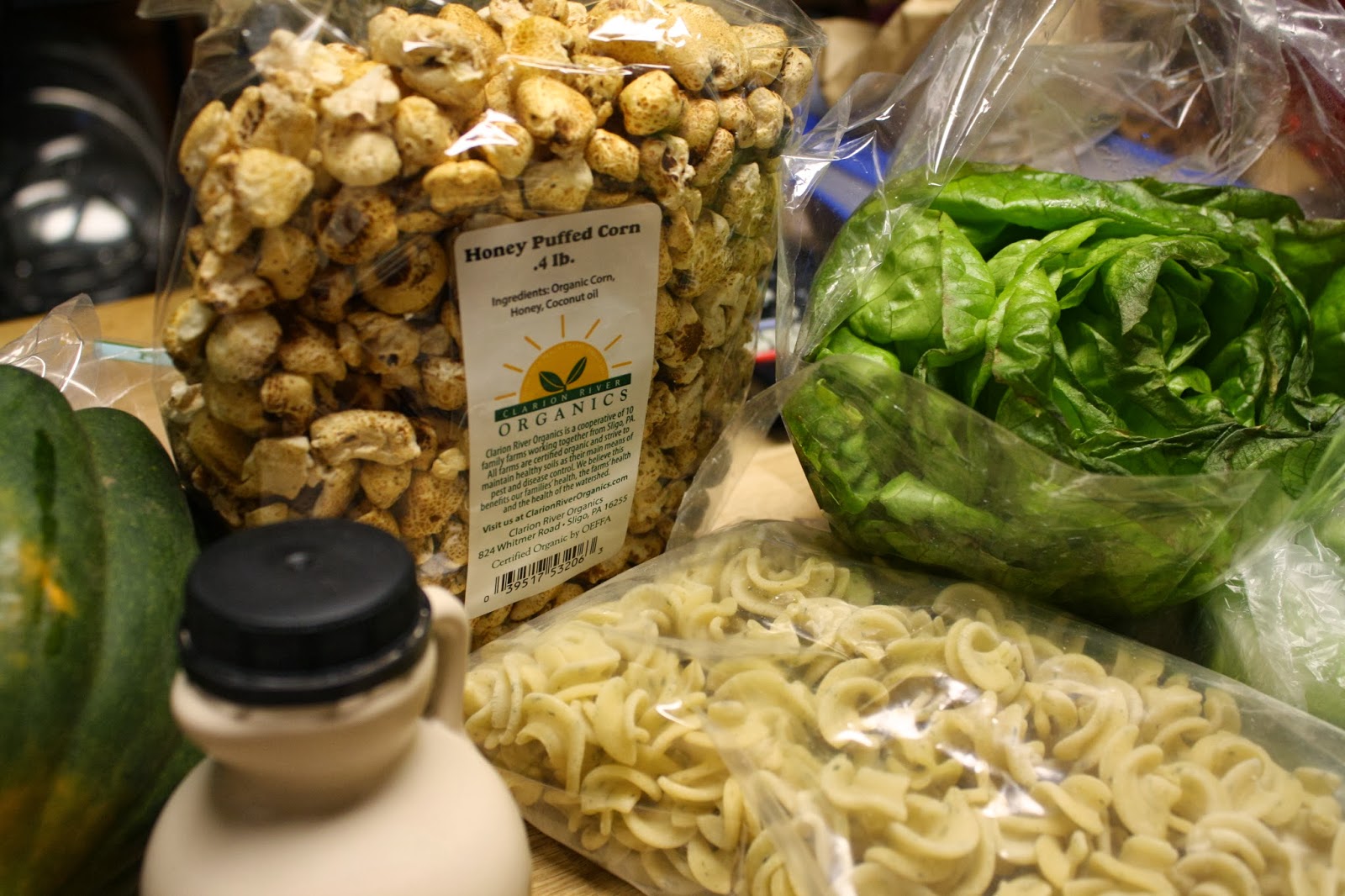
After a brief holiday break, we got our third winter share. I might have actually squeed out loud a bit when I got the email saying what we were getting this week. Cheese, pasta and honey puffed corn in the same week? Heaven!
Here's what we got!
The eggs (Heritage Farm) are a great supplement for us, since our chickens aren't producing at the rates they do in the seasons with lots of daylight.
Garlic (Blue Goose Farm, certified naturally grown) and squash (Kistaco Farm) will go down in the basement to stay cold for awhile. I'm thinking of making some muffins with the apples (Dawson's Orchards).
This cheese (Riverview Dairy) will be great to try. It looks similar to a hard cheese like parmesan, but who knows if that's how it will taste.
I never liked real maple syrup as a child, even though my dad kept telling me how good it was. Now I wouldn't touch Aunt Jemima with a 10 foot pole. Give me the real stuff! (This syrup is from Weeping Willow Farm.)
In addition to the cheese, I'm most excited about the honey puffed corn (Clarion River Organics, organic) and pasta (Fontana Pasta). The pasta is fresh, so I froze it right away since we already have our meals planned out for the week. You can boil pasta straight from frozen.
The honey puffed corn is just like corn pops, but without all the crap and chemicals. I could eat this stuff like candy.
The lettuce is hydroponic (Harmony Grove) and has been great in the other shares. The other green wasn't specifically identified, but I think they look just like baby bok choy, so that's what I'm going with (Goose Creek Farms, certified naturally grown). I have a great recipe for sauteed bok choy with great Asian flavors, so this might end up in a side.
My favorite part about this share with Penn's Corner so far is the great variety. It's so much more than just root vegetables and squash - the things you can easily store over winter. For a season that is usually pretty dreary in the fresh food department, this share has been wonderful. Can't wait til share #4!
Side note: For more info about certified naturally grown and what that means, check out this post.
Here's what we got!
The eggs (Heritage Farm) are a great supplement for us, since our chickens aren't producing at the rates they do in the seasons with lots of daylight.
Garlic (Blue Goose Farm, certified naturally grown) and squash (Kistaco Farm) will go down in the basement to stay cold for awhile. I'm thinking of making some muffins with the apples (Dawson's Orchards).
This cheese (Riverview Dairy) will be great to try. It looks similar to a hard cheese like parmesan, but who knows if that's how it will taste.
I never liked real maple syrup as a child, even though my dad kept telling me how good it was. Now I wouldn't touch Aunt Jemima with a 10 foot pole. Give me the real stuff! (This syrup is from Weeping Willow Farm.)
The honey puffed corn is just like corn pops, but without all the crap and chemicals. I could eat this stuff like candy.
The lettuce is hydroponic (Harmony Grove) and has been great in the other shares. The other green wasn't specifically identified, but I think they look just like baby bok choy, so that's what I'm going with (Goose Creek Farms, certified naturally grown). I have a great recipe for sauteed bok choy with great Asian flavors, so this might end up in a side.
My favorite part about this share with Penn's Corner so far is the great variety. It's so much more than just root vegetables and squash - the things you can easily store over winter. For a season that is usually pretty dreary in the fresh food department, this share has been wonderful. Can't wait til share #4!
Side note: For more info about certified naturally grown and what that means, check out this post.
Subscribe to:
Posts (Atom)