If the point of a documentary is to get people to critically think about an issue, Vegucated certainly met its goal for me, though it caused me to scribble furious notes and get riled up more than any other documentary I've watched so far.
Vegucated follows three people who agreed to go vegan for a period of 6 weeks, undergo a health screening before and after, and be educated about why someone should choose to be a vegan. Childish cinematography aside, I didn't want to hate this film. I felt like it meant well, but veered off into a lot of what I felt was misleading information.
First, my disclaimers. I think anyone should be able to pursue the diet of their choice. I respect vegetarians and vegans for their diet choices and see the myriad of benefits diets such as these provide, not only for animals and the environment, but for individual health. However, if the choice to live by those diets involves twisted logic (which is then used to attack what I'd call an ethical omnivore diet), that's where I have an issue.
When the three participants decided to go vegan for the purposes of the film and were beginning the transition, the filmmaker/narrator emphasized that they should look for vegan versions of their favorite products to ease the transition. This film was so full of processed foods, it made me ill. I'm not sure why someone would choose to give up dairy or eggs, only to constantly eat heavily processed foods with artificial additives and GMO soy. Processed foods have a huge impact on the environment and vegan versions of regular processed junk are not at all more healthy. To wave GMO soy milk and veggie/soy burgers packed with a list of 30 ingredients and claim that it's the epitome of health is misleading. If I saw one more person waving a container of Earth Balance around acting like it was health food, I was going to scream.
Along those same lines, the filmmaker points out all the wonderful restaurants where you can eat vegan - like Subway! and Johnny Rockets! My question is this - even if you eat a vegan option at Subway, you are supporting a corporation that does not support environmentally sustainable practices, and sources the meat it serves to other people from the worst of the factory farms they claim to not support. So it rings false to me when you claim veganism is good for the environment, but give your money to the exact corporations that destroy it.
There was a great deal of footage from factory farming operations in this film, which in some ways is great. I applaud any effort to get people to stop eating factory farmed meat. I've written about that before, as well as made clear my support for defeating Ag-Gag laws. If the only meat available were from factory farms, I'd never eat another bite for the rest of my life. Factory farms are atrocious and disgusting in the extreme and should not even be allowed to exist. However, the filmmaker/narrator doesn't just stop there with farms - she visits a "small, family farm" and claims it's just as bad as factory farms. No kidding. The "small, family farm" that she showed had a CONFINEMENT SYSTEM for its chickens.
The farms where we source our meat absolutely would never use a confinement system. I've been there and seen it - I don't have to go undercover with a camera because they openly welcome people to visit. While I think people can legitimately have ethical issues with eating animals, it is unfair to paint all meat eaters as people who allow animals to suffer. Not everyone who drinks milk sources the milk from a cow who had her calf ripped away from her at birth.
Another argument that doesn't hold up is that all animals raised for food contribute to environmental decline. It's true that factory farmed meat is terrible for the environment, and the majority of grain production in the country (as well as most of the antibiotics, incidentally) goes to raising these animals. Last time I checked, our farms allowed their cattle to graze on pasture, not grain shipped in from across the country. They also use their manure to fertilize fields, not trap it in a waste lagoon and then spray it everywhere, contaminating water supplies. They use rotational grazing methods that are sustainable. They don't destroy the earth - they nurture and protect it.
And this doesn't even touch the health portion of this film. Yes, in 6 weeks the three people each lost a few pounds and saw benefits in their blood pressure and cholesterol. And it's a fact that a plant-based or plant-heavy diet that's low in saturated fat and cholesterol is great for your health. But these people were not active and also continued to eat junk food - but it was vegan junk food, so it was "healthy" (ooh, Teddy Grahams are vegan!). These people are obviously not representative of all vegans, but to promote it as a healthy lifestyle while still encouraging people that they can eat processed cookies is wrong. "Vegan" doesn't equal health any more than "organic" equals health.
Ultimately, to paint all farms and meat eaters with such broad strokes is irresponsible. I know many vegans and/or vegetarians that eat a whole foods diet and don't rely on processed garbage as an "easy way out." But this film made me feel like I was on one side of a war, good (vegans) versus evil (everyone else). In actuality, I think an ethical omnivore has a lot more in common with a vegan than most people would assume - both are conscientious eaters, aware that what we eat involves much more than just mindless bites. So why can't we just get along?
This is our next to last share for the season, and even 24 weeks in, we're getting new items!
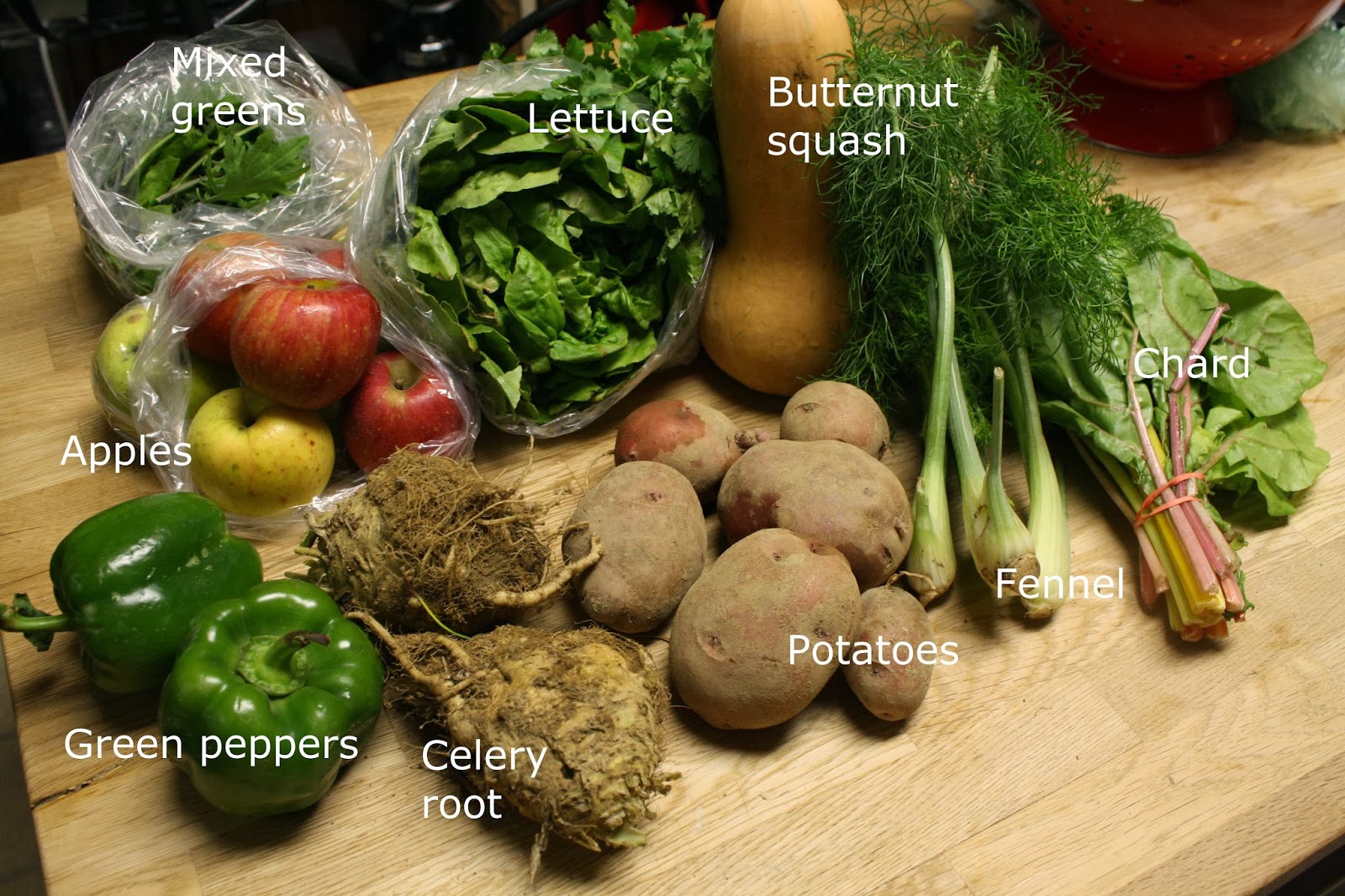
New this week is celery root - the two dirt clod looking hairy roots. We've made that into celery root puree (friends who have the same CSA were able to donate theirs to us as well due to an allergy so we had double!). Don't they look like something out of a Hogwarts botany class?
More apples this week. Been eating these dipped in lemon juice and with peanut butter as a snack. Delish!
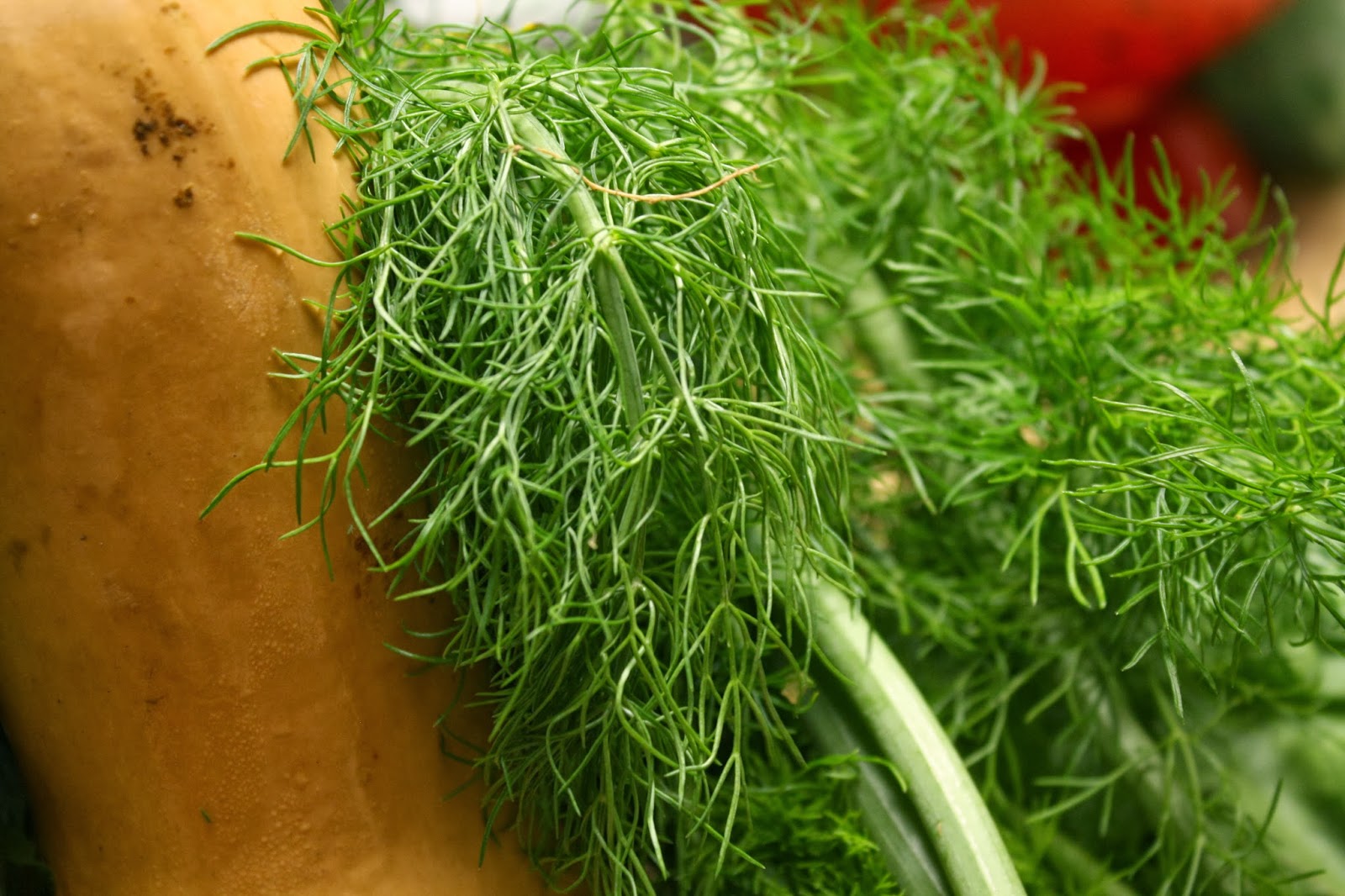
I usually make a fennel and sausage pasta when we get fennel, but since this is a smaller amount, I might look for something else. But look at these fronds. Crazy.
Very happy for more chard too. It made a great side with the celery root puree this weekend.
Mixed greens and peppers will find their way into salads. The potatoes were a side with coq au vin (Julia's coq au vin) on Sunday.
Just one more week. Stay tuned!
I spent as much free time as I could spare in October working on simplifying my life in one specific area - belongings. After taking a hard look around my house (and realizing that some closet doors hadn't been shut in months - or *shudder* years), I knew I needed to start the process of organizing and sorting and cleaning, no matter how long it took.
I started with our spare bedroom/office and moved my way through the upstairs. I made piles upon piles of items to toss, store, donate or sell. Right now, our dining room is full of boxes that need to be stored for the spring, when I'll be joining some friends in a yard sale. It's now past my October "deadline," but I am done with everything but the basement and 50% of the kitchen. (Doing the kitchen requires me to have the basement clean with some new storage areas for things that can't live in the kitchen any longer. I'm looking at you, canning stuff!)
Even though there's still a lot to be done, I can acknowledge how far I've come in parting with items that really contributed nothing to my life but a growing sense of my belongings closing in on me. The piles of stuff were always sitting there, mocking me and making me feel guilty and overwhelmed. The dust on the piles showed just how little the items were actually used.
I've sold about a dozen books on Amazon and been able to put aside some great stuff for my little niece, both for now and when she gets older. And I am really happy that I can add to my sense of peace by providing stuff for other people that might get use out of it.
I'm being much more mindful about what comes in and out of the house, and I'm not buying things without a specific purpose for them. I've also learned that a good barometer for whether or not you should get rid of something is if you've used it in a set time period. For example we had a metric ton of board games - ones I had collected in college as I sought to own every Trivial Pursuit ever created - as well as the more advanced variety like Munchkin and Pandemic. I went through each game individually and asked myself - have we played this in the last year? If I had a game night tomorrow, would I want to play it? If the answer was no, it went in the pile.
Having a plan really helped. But what helped the most was finishing that first room. It made me realize how much peace came with accomplishing a task that had sat unfinished for so long as well as the calm that comes with space, margin and order. That great feeling pushed me forward.
My big goal is to finish the basement and kitchen before Thanksgiving so that after the holiday, we can pull out our Christmas decorations and feel like we don't have to strategically place them around piles of clutter. I can't wait to enjoy the holidays without thinking "I was meaning to get around to this..."
Have you had any simplifying success this fall?
This was a big week for us, CSA-wise. A great final meat share from Clarion River Organics and our next-to-the-last produce share from Kretschmann Family Organic Farm.
I usually take photos and gush about all the goodness that we are so blessed to have. But I'm not posting them until next week. Why? Because if the proposed rules for the Food Safety Modernization Act go into effect unchanged, as currently written? There might not be any more Real Life CSA posts. There might be many less small farms, community supported agriculture programs. The farms in our community that we have come to love would have their viability threatened, and who knows how many shares they could support, if any?
There wouldn't be any photos of organic greens, because the compost restrictions would make it hard to grow those locally. We wouldn't benefit from the years of accumulated agricultural knowledge that our farmers carry, because they'd be told to sanitize, sterilize and modernize, with no regard for what that actually means on a practical level. The restrictions on wildlife encroaching on crops? Have these people BEEN to Pennsylvania? Do they think deer will respect property lines?
The Pittsburgh Tribune-Review featured Don Kretschmann, the owner of our produce CSA, in an article yesterday that shows you in photos how his farm is threatened by these FSMA rules. Read it.
Both of our CSAs have spoken up about how it would affect them. Read about it here and here. These are not groups that are typically outspoken about their political views. They're too busy planting things and harvesting things. But it was important enough for them to take time out to speak up, and we owe them a few minutes of our time to comment in support.
I know I have mentioned this issue and the importance of commenting on these rules many times over the last couple months, and I've tweeted about it a lot too. Here's the thing. Being a CSA subscriber is a great joy for us - and that's not hyperbole. It's a privilege to be able to source such wonderful food locally - one that we don't take for granted. I might not know the technical ins and outs of farming and I'm no food policy expert. I'm just a normal consumer that can't imagine a summer, or a winter for that matter, without my local farms.
Americans love to complain about our government. I think we can be disillusioned with the democratic process sometimes, feeling voiceless in the face of what feels like so many things we can't change. But this is a chance to participate and to use your voice. All the things they taught you in elementary school about government? This is where it comes alive.
For more information on how to comment, TODAY, before it's too late, visit the National Sustainable Agriculture Coalition's FSMA section here.
I used to be addicted to the Food Network. I knew every chef, every show, every dish. I would even credit my beginnings in the kitchen to my exposure to it (since I didn't lift a finger in the kitchen until I lived on my own and got sick of eating microwave macaroni and cheese). The Food Network made me want to elevate my own culinary experiences to the level of "delicious" and not just "adequate."
But at a certain point, I started to outgrow it. I didn't need the chefs to educate me anymore. (And I also grew dismayed at how disconnected Food Network programming is from the larger issues of food in this culture - hunger and agriculture, primarily. But that's another story.) To me, the programming all became shiny and glossy on the surface and not enough substance underneath. And really? No one's food ever looks like the dish on TV because it isn't touched by 4 stylists between the kitchen and the plate.
Julia Child's The French Chef was America's first real cooking show - like the great grandmother of what you see now on the Food Network. But they wouldn't air her show in today's lineup, unless it was in the context of a tribute or documentary on the origins of food entertainment. Why? Because it's real.
I'm listening my way through a book about Julia Child and am gathering ideas for a Mastering the Art of French Cooking themed dinner. Being on a Julia kick, I recently watched through some of the episodes of The French Chef. (Available for free on Amazon Prime, and also on DVD.) They are utterly enchanting in all their imperfection. No fancy camera angles, no lens flares or vibrant colors, even when the program started appearing in color. What you see are messes, stacks of dishes, improvisation and mistakes. She laughs at herself and tells you not to take yourself too seriously. After all, if a classically trained chef can screw up an omelette flip, we can too! I can't imagine any Food Network chef telling me to have the "courage of my convictions" in the context of eggs.
In one episode she realizes she doesn't have the right lid for the pot she's trying to cover, so she sticks something else over it with a shrug. Today's food shows would do as many takes as it required to get it right. Would you ever see Sandra Lee with a big splotch of wine on her pristine white shirt? Or the Barefoot Contessa wiping her hands on her clothes? Watching Julia is watching a reflection of me in the kitchen. (Just a 6'3" version of me in heels and an apron.)
You can also feel how genuine her happiness is when something turns out right, because it's instant and isn't rehearsed. The woman makes her own sound effects when she moves garlic through a press and into her dish. If that's not joy in cooking, I don't know what is. (And I will henceforth exclaim "sploosha!" when I use my garlic press.)
If you have ever had the experience of wanting to make a dish worthy of the Food Network, but are intimidated by the process, watching Julia removes that barrier. Your kitchen doesn't have to be fancy or pristine, your tools state of the art, or your chopping skills mastered. You just have to have the courage to try in the first place.
Startups Try to Reroute Food Waste to the Hungry (NPR)
Really interesting article about ways to save food that would otherwise be wasted. This is no small feat - but these groups are doing amazing work. One group has saved over 300,000 pounds of food so far!
Whole Foods' New Produce Ratings: Transparency Bears Fruit (Civil Eats)
Whole Foods is introducing new ratings for their produce and flowers, similar to those used for their meat products. The model is a "good," "better," "best system. I really appreciate that these labels won't just take into account the environmental conditions under which the products are grown, but also the treatment of those people who grow them and harvest them. I'm a huge fan of transparency, and Whole Foods is a leader in this regard.
Scientists Say 'No Consensus on GMO Food Safety' (Food Democracy Now)
A group of scientists and physicians released a statement asserting that no scientific consensus has been reached on the safety of GMOs. This is important because many groups are using "science" to back up their positions about the safety and/or danger of GMOs. I actually think that one of the best arguments for GMO labeling is exactly this - we don't KNOW what GMOs do. So until we do, shouldn't products be labeled?
FDA Ruling Would All but Eliminate Trans Fats (NY Times)
The FDA has proposed eliminating artificial trans fats, a major known contributor to heart disease. They'd eliminate them by removing the "generally recognized as safe" label and requiring companies to prove they are safe, which is unlikely considering the medical evidence. It's being lauded as a big step in public health, and it is, but knowing the FDA, it seems like anything can happen.
We're winding down with the CSA for this season. I have been thinking back over the 23 weeks we've had so far and realized that we've done so much better this year with drastically reducing any waste. We're learning how to plan meals to keep up with the ups and downs of the season. It's almost like a rhythm that we're learning to follow and anticipate. Even 23 weeks in, we have a new item this week!
We've had cabbage and beets this season, but not frequently. I'm thinking haluski or cabbage rolls, which ironically I never liked as a child but love now.
Radishes, greens and carrots will accompany the salad greens. Might actually try to do something with the beets, even though I haven't found a recipe yet that I've actually liked.
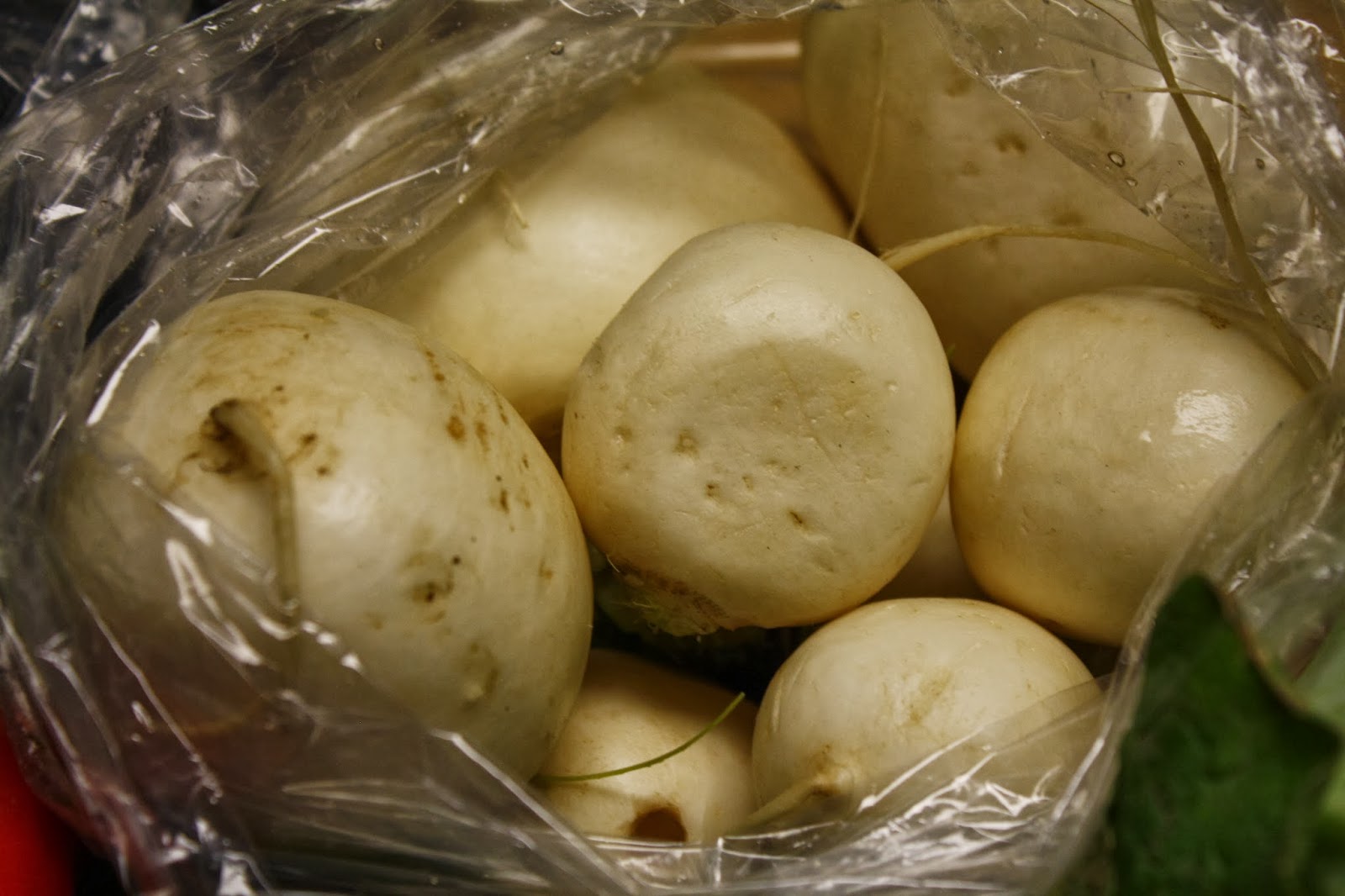
New this year, turnips!
We've been enjoying the greens from the turnips, but now we have the real thing. I've seen multiple ways to prepare these, similar to potatoes - scalloped mashed, gratined. Now just to pick one!
More apples this week. These might need to be made into a dessert - perhaps a galette?
When I reached in the bag, I grabbed this pepper and nearly put my fingers through the soft spots, so this will make a great treat for the chickens tomorrow!
We also had some hitchhikers this week. I put away all the produce and found these guys hanging out on the island.
Live bugs (and those that scurry like mad!) mean the produce is really fresh, so I never mind finding them. At least before I use the veggies!
Last week is likely the final week of our spring/summer/fall share. That means it's almost time for our new winter share! We're never short of produce at Next Gen House - that's for sure.